
Sigfrid’s Notebook
A very long, semi-sad story about the origins of Marxism
[This post is the second and probably last pre-planned digression from the topic of Brumaireland this year, the “bourgeois republic.”]
All I remember about The Swerve is that it began with the discovery of a manuscript. Was it Epicurus? [No, stupid. It was Lucretius. - ed.] It spawned modernity.
Well, I discovered a manuscript, too.
It was an undated notebook, labeled “18 brumaire,” on some microfilm at the New York Public Library, in the papers of an early Marxist in the United States, from the time of the First International, named Friedrich Sorge.
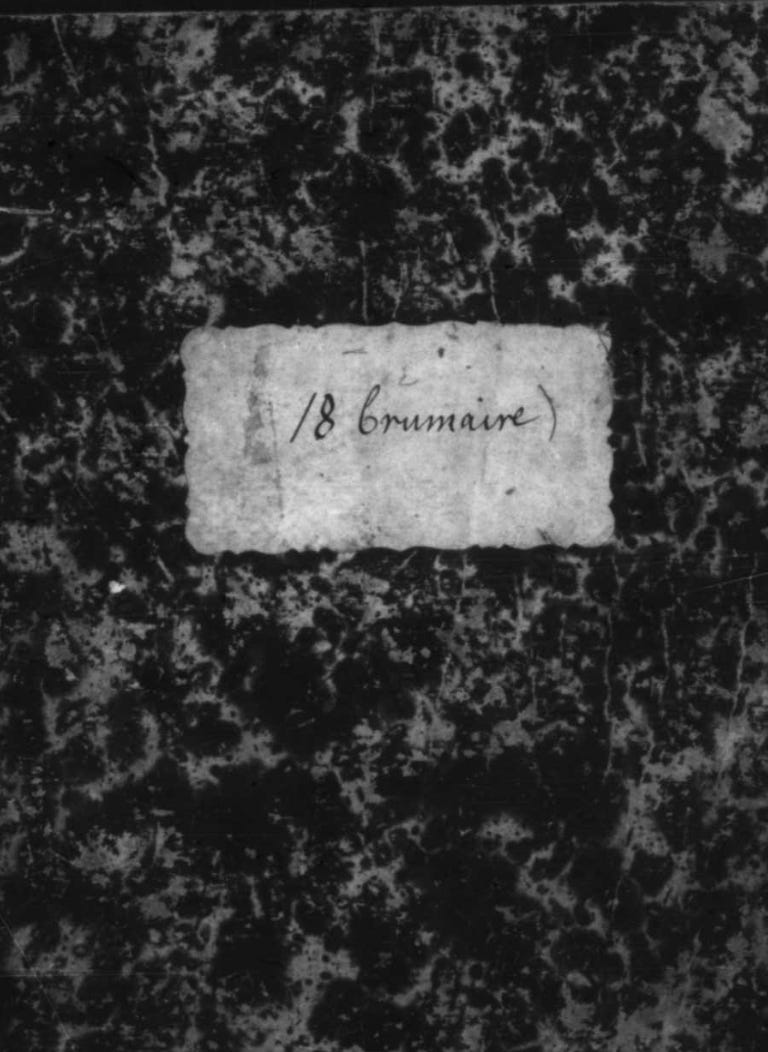
It’s a little absurd to claim to “discover” something that’s already in an archive, let alone on microfilm, in a public library. But I doubt that anyone else knew that the notebook was there.
Inside, someone long ago had carefully copied out the entire text of the first edition of The Eighteenth Brumaire of Louis Bonaparte, some 62 pages of printed text, filling some 133 pages in the notebook.
As if that wasn’t weird enough, the text had been edited.
Just a little. I noticed two words missing from the famous opening sentence. Two paragraphs were crossed out in the first chapter.
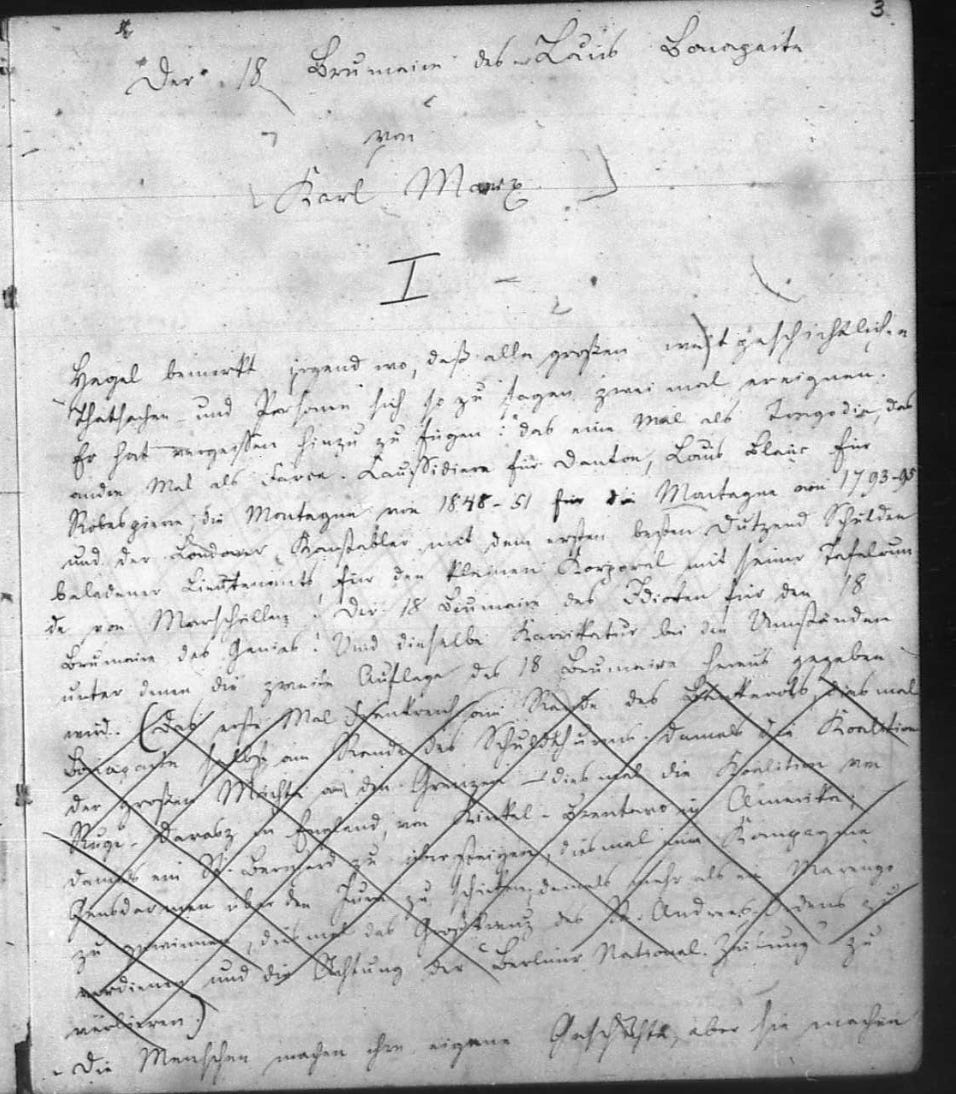
The changes were partly the same as changes that Marx would make for the second edition, in 1869, but not exactly. The notebook was clearly made before then, and the handwriting didn’t belong to Marx.
It wasn’t Friedrich Sorge’s, either. I didn’t know why it was in his papers. There was no name on the notebook and no information about it in the library catalogue.
The original owner had also made copies of two other, shorter, not so famous texts, “The Festival of Nations in London,” by Engels, from 1846, and Two Speeches on Free Trade and the Question of Protectionism, a pamphlet by Marx published in June, 1848. And on the last few pages there were a few loose notes, including excerpts from an even more obscure pamphlet by Marx, The Knight of Noble Consciousness, first published in New York in January, 1854.
I’ll be honest, I’ve never read The Knight of Noble Consciousness. I would bet that many or even most specialists in Marx have never even heard of this pamphlet, which continues the fight with the so-called Willich-Schapper faction, the more revolutionary (or “adventurist”) rivals of Marx and Engels in the Communist League, that Marx began in Revelations of the Cologne Communist Trial.
By this point the argument involves increasingly minute responses to criticisms of claims that don’t even make sense without more background knowledge than pretty much anyone actually has today about political groups and arguments among German refugees in 1850-1851.
It’s understandable that the original owner of the notebook did not feel compelled to copy The Knight of Noble Consciousness in full, apart from the fact that there were just a few pages left in the notebook by this point.
But it’s incredible that he studied it at all.
What was I even looking at?
I wanted to call it the first Marx-Engels anthology ever made, but it was something more primal: a collection.
The original owner must have been one of the first followers of Marx, from a time before the word “Marxist” is even known to have existed in any language. The word “Marxism” came even later.
Someone had been gathering up these scattered writings—hard to find even when they were published, their existence probably not even documented anywhere at all in print, only possible to find by word of mouth—and copying them by hand.
But who? And why?
With a little time, maybe years, I was able to identify the original owner of the notebook and to date it, I think, pretty precisely. I came up with a theory about the revisions, too, that they were made by Marx himself, on the printed copy of the Brumaire that the scribe was copying in turn.
The revisions themselves are a story for another post, maybe. I can only explain here briefly what happened.
In late 1864, Marx made some revisions to a copy of the Brumaire that he sent to Berlin as a part of a failed attempt to publish a new edition. This revised copy, now lost, came into the possession of his follower Wilhelm Liebknecht, who kept trying to republish the book without success. When Liebknecht was expelled from Berlin (and Prussia) in the summer of 1865, he took the revised copy of the Brumaire, if I’m remembering right, with him to Saxony, where he thought he might a find a publisher.
The following spring, the original owner of my notebook (about whom lots more to come) wrote to Liebknecht to ask to borrow a copy of the Brumaire, explicitly so that he could make a copy.
All that, I believe, is clear from published letters. My theory about the notebook only adds the seemingly reasonable assumption that Liebknecht sent the revised copy to Berlin, and that the revisions were dutifully copied, too, maybe still with the idea of a possible republication.
But it took me some time to reconstruct this chain of events. At first, as I said, I hardly even knew what I was looking at.
Nor was I confident that the notebook really mattered so much for my research, which was ultimately oriented to the historical interpretation of Marx and not just everything having to do with the Brumaire, not to mention the other contents of the notebook and the life of its owner.
Knowing so little about the notebook at first, I couldn’t very well use it for anything at all. I just made a digital copy and set it aside while I waited for my epistemological luck to improve.
Even when I knew much more, I would be able to include just a few paragraphs, maybe a page or two, about the notebook in my book.
But on the Internet, all possible topics of research are equally close to God.
Eventually I recognized some of the handwriting.
Most German handwriting from before about the Second World War is in a cursive called Kurrentschrift that is mostly unintelligible to an untrained reader (me).
The cursive in the picture above is sort of in between. Not so bad. But parts of the notebook, very unusually, are in a very normal Roman Schrift, even what in America I think we call block letters, that is, not cursive at all.
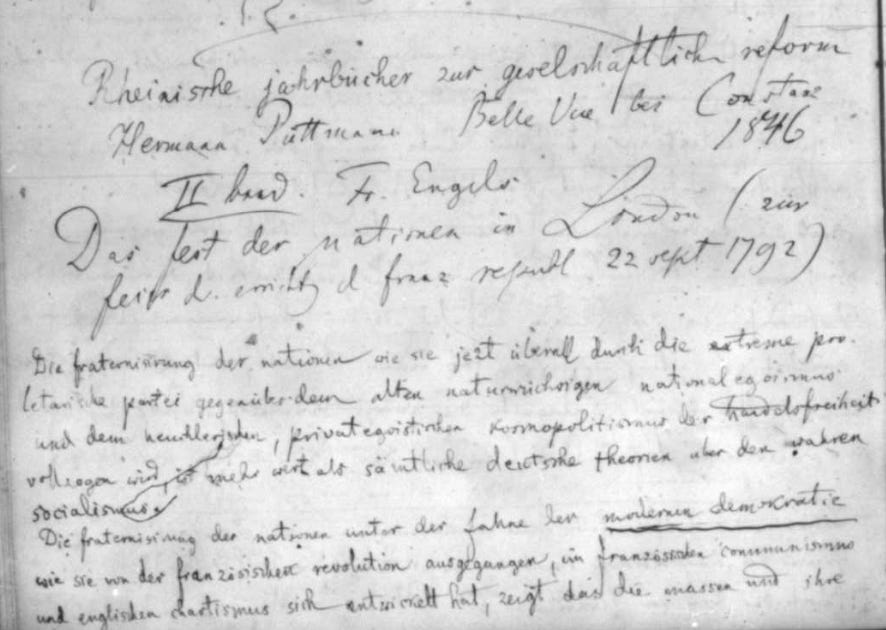
Even if you don’t read German, you can probably make out most of the words on the bottom of that page: “Die fraternisierung der nationen wie sie jezt [sic: jetzt] überall die extreme proletarische partei,” etc., etc.
The fraternisation of nations, as it is now being carried out everywhere by the extreme proletarian party in contrast to the old instinctive national egoism and to the hypocritical private-egotistical cosmopolitanism of free trade, is worth more than all the German theories of true socialism put together.
In the digitized Marx-Engels Papers, on the website of the International Institute for Social History, in Amsterdam, I came across a few letters to Marx that were unusually clear in just the same way, from an obscure member of the First International in the United States named Sigfrid P. Meyer.
That’s how he spells his first name, although he is often called “Siegfried” in scholarship.
Sigfrid! My man!
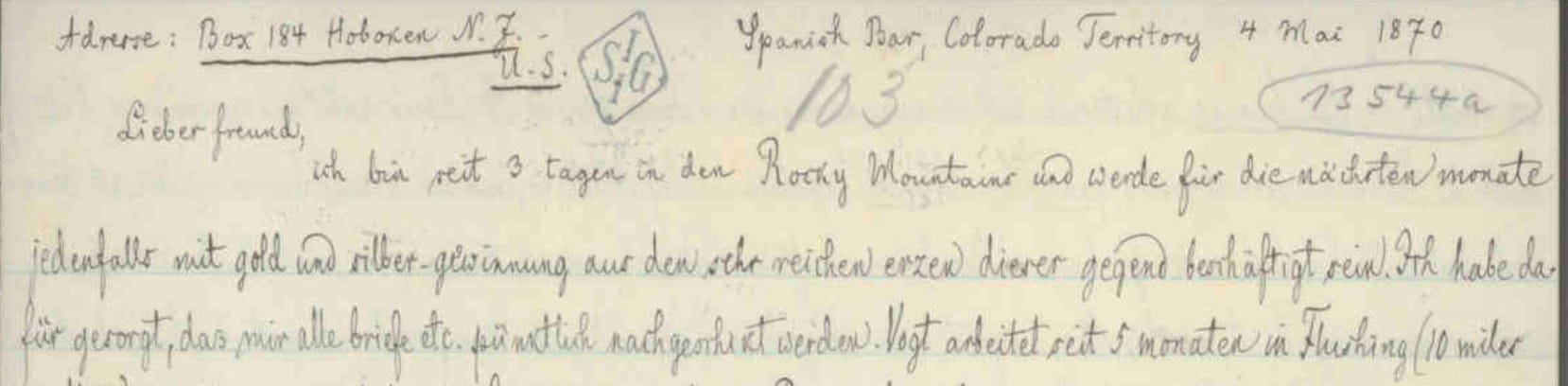
The letters caught my attention at once, not only because I could read the handwriting easily for a change but because of their incredible contents. In this one, for example, Meyer is writing to Marx from Colorado Territory, where he’s been mining for gold and silver.
And the handwriting sure looked the same to me. But it was still just a hunch. I’m no handwriting expert.
There’s not much information about Meyer online. What comes up most of all is a letter from Marx to Meyer and his friend August Vogt, a shoemaker, another pioneer of the International, from April, 1870, about political organizing among immigrants.
Marx compares the hatred of the English working class toward the Irish, “as a competitor who lowers his standard of life,” to the attitude of “the ‘poor whites’ to the Negroes in the former slave states of the U.S.A.” He goes so far here as to call this hatred “the secret,” full stop, “by which the capitalist class maintains its power.”
Meyer or Vogt come up relatively often as minor figures in close histories of the First International that focus on Germany or the United States, where they both migrated in 1866. But mostly they’re just mentioned as these people that Marx was corresponding with. There’s almost nothing about who they were.
After more time had passed I found an old article by Sorge himself, from 1899, about Meyer and Vogt, a kind of tribute to them both as “Pioneers of the International in the United States.”
There’s even a picture of Sigfrid Meyer!
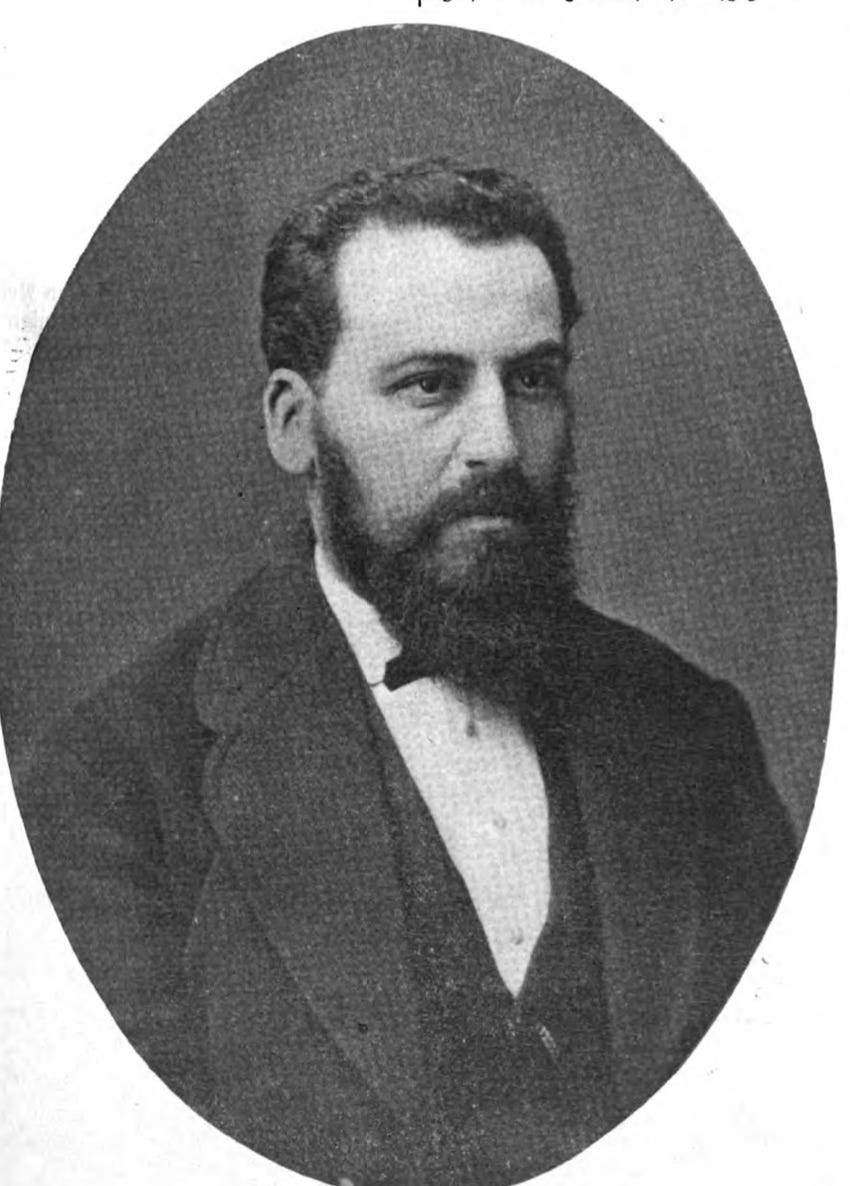
Sorge says that Meyer was a “mining engineer.” He uses a German word for that first, then the English, as if this job was not yet familiar.
Another old PDF on my laptop (Herman Schlüter’s Die International in America, from 1918) says that Meyer was “the son of well-off parents” and was or had been a student at the Technische Hochschule in Berlin. Wikipedia says that the Technische Hochschule in Berlin didn’t exist yet back then, but its predecessor, the Bergakademie, the mining academy, apparently reopened in the fall of 1860.
In any case, Meyer “gave a large part of the means that his parents made available to him to agitation.”
Meyer apparently got involved in politics first through the Nationalverein, a liberal organization founded in 1859, promoting a “little German” (Prussia-centered) path to German unification.
“Until 1860 (when I was 24),” he writes in one letter from 1865, “I was merely a political chatterer and screamer (schwätzer und schreier), naturally a member of the Nationalverein …”
But Meyer was not affiliated with it for long. In the same letter, he credits three writings from 1861 by a journalist named Lothar Bucher for making him think more seriously about politics for the first time.
Bucher was an important figure in this period of Prussian history about whom I know little and can’t find out more right now for Substack, especially not without violating my principle of anti-borgism, not to write more than absolutely necessary about things that can be Googled.
Meyer uses a funny word for these writings by Bucher: he calls them Männerschriften, “men writings.” Is that a typo in the printed version of the letter? I assume he means Mahnschriften, “admonitory writings,” texts that tell people what to do.
After, fine, just a little Googling, I think the three texts he means are a declaration from January 1861 and two pamphlets co-signed by others but probably written by Bucher, Seid deutsch! (subtitled Ein Mahnwort) and An Mazzini.
My theory so far is that an otherwise typical liberal-bourgeois student of mining got mired in debates about the great questions of the last revolution, the unification of Germany, its political form, its relationship to other national movements, and came to political economy and Marx that way.
Sorge claims that Meyer was first interested in the “labor question” by Ferdinand Lassalle, and through studying the question further, became a fanatical follower of Marx.
Meyer was for some time a member of the Berlin circle of Lassalle’s Allgemeine Deutsche Arbeiterverein (ADAV), a kind of proto-party organization that campaigned for mass suffrage and state-supported producer’s cooperatives.
This “Berlin circle” varied in size, so I’m not sure how big it was just then. Maybe just a few dozen members, so about the size of Brumaireland. Wilhelm Liebknecht was active in this “circle.” Many of its other members were shoemakers, but it also included, for example, at least two doctors and a bookdealer.
It’s not clear from the sources available to me right now when exactly Meyer got involved with the Lassalleans. But maybe it was in July, 1865.
In a letter from October of that year, to Wilhelm Liebknecht, Meyer thanks him for “the kindness with which you supported me in July of this year, in my efforts to gain a deeper understanding of the great cause that inspires us all.”
Liebknecht had also apparently introduced Meyer to Vogt, perhaps already among the shoemakers in the Berlin circle of the ADAV, “from whom I have learned so much in the recent months,” Meyer wrote, “the friendship of whom I am striving to earn.”
In the mid 1860s, Sorge believed, Meyer republished the Communist Manifesto.
In fact, it was in 1866, and probably the first time that the Manifesto was ever published in Germany. And “at about the same time, in his few leisure hours,” according to Sorge, Meyer “copied out the 18th Brumaire … a time consuming labor that he undertook only because he could not buy a copy of the text at any price.”
Unbelievable! My notebook!
Is it just a coincidence that Meyer copied the Brumaire “at about the same time” as he republished the Manifesto? Maybe he was thinking about republishing the Brumaire, too. But maybe Meyer was just obsessed.
“Wherever he could find anything written by Marx,” Sorge says, “he bought it, unconcerned by the price, and studied it with incredible dedication. The evidence of that is in his copies of Herr Vogt, Zur Kritik der Politische Ökonomie, Miseré de la Philosophie, Deutsch-Französische Jahrbücher, and so on, which he filled with his notes—Herr Vogt alone with more than 100.”
Herr Vogt has nothing to do with Meyer’s friend, the shoemaker August Vogt, although it does have something to do with Liebknecht. But I can’t get into Herr Vogt here, or we would never get out.
According to Sorge, Meyer also studied political economy, Adam Smith, David Ricardo, and “others,” with another friend, an unnamed Gerichtsassessor (“court assessor,” a kind of apprentice judge—not a good job), “but more important to him was his acquaintance and friendship with the shoemaker Vogt …”
Vogt, as I said, was one of those “political shoemakers” that Hobsbawm and Scott write about in their classic article. He had been a member of the original Communist League.
A cobbler once in days of yore
Sat musing at his cottage door.
He liked to read old books. he said,
And then to ponder, what he’d read.
— From “The Cobbler and the Likely Bor: A Norfolk Ballad,” in Thomas Wright, The Romance of the Shoe, Being a History of Shoemaking in All Ages, etc. (1922), p. 217, as quoted in Hobsbawm and Scott, “Political Shoemakers,” etc.
I love the Hobsbawm and Scott article, which tries to explain what it was about shoemakers that gave them the reputation, across centuries and in many different languages, of being an unusually bookish and radical group.
They consider many different theories, only a few of which I can remember.
My favorite is that shoemaking was not physically hard work, so it attracted weak and often disabled men who had to earn social prestige in other ways. Also, they hypothesize, shoemakers did not depend on rich people for their income. Pretty much everybody needs shoes. This gave them, perhaps, more independence. (In the old days, in contrast, poor people made their own clothes, for example, so tailors mainly served the rich.) Also shoemaking involves a lot of time alone just to think.
According to Sorge, Meyer and Vogt were both Prussian. I liked them immediately.
By the time that Meyer wrote to Liebknecht in October, he was deep into Marx, partly thanks to Vogt: “I have borrowed from Vogt the manifesto and copied it out,” he wrote. This was obviously before they published the new edition. “I have also got the 18 Brumaire to read.”
And his newfound passion for reading Marx didn’t stop there!
“I am longing in particular for The Holy Family, as I believe the philosophical critique of the Hegelians is titled, because I am inclined toward philosophical research, even though I, as principally a naturalist, reject all speculative philosophers, even when they, like Lassalle, have demolished Hegel’s fundamental errors.”
Huh. I wouldn’t have guessed that Meyer was “inclined toward philosophical research.” Also he sees Lassalle as a critic of Hegel, even a major one? Not the received idea in scholarship, as far as I know.
Meyer also asked Liebknecht for the name of a bookseller who might have a copy of the Brumaire, and Marx’s now mostly forgotten pamphlets on Lord Palmerston. He was also eager to read any political writings by Engels.
Soon after that letter to Liebknecht, Meyer and Vogt, as well as a certain Theodor Metzger, co-wrote a long and formal letter to Marx himself.
Wertester Herr, their letter begins, “Most Worthy Sir.” The whole letter has a kind of formality about it that I think is making it hard for me to translate.
“The consciousness of intellectual dependence on writings by you and Engels, admittedly known to us only partly,” their statement begins, “encourages us to depict for you the current situation of German workers.”
In fact, they were writing to ask him to come back to Germany!
The ADAV had been in crisis since the death of Lassalle in a duel in August, 1864, which was followed by a struggle over both leadership and strategy. But let them explain!
“The attempt to organize the German worker’s party that was made 2 1/2 years ago,” they write about the ADAV, “grafted Caesarism onto democratic principles.”
I may have to get back to this issue of “Caesarism” in a much later post, like at the very end of Brumaireland. I can only note here one definition from the time, by Walter Bagehot, in Marx’s favorite magazine of all time, the Economist.
Bagehot was criticizing what the regime of Louis-Napoleon Bonaparte (now Napoleon III) had become. What Bagehot called “Caesareanism” was the rule of a “Benthamite despot,” who in theory provides the greatest good to the greatest number. But this benevolence comes at the “painful” cost of political repression, corruption, an unstable dependence on the abilities of a single man, and a neglect of other economic needs, such as the availability of credit.
There was a whole argument about “Caesarism” in Germany in the 1860s because of Bismarck. I have a chapter about it in my book, and it was not the most pleasant to write. Marx himself hated the word “Caesarism” so much, he wrote in the preface to the second edition of the Brumaire that he hoped his book would help to destroy it—the word!
Meyer et al. were also unhappy about Lassalle’s leadership. “Insofar as Lassalle simultaneously fought for independent thought and against (mere) opinion,” they write, “he forgot nothing less than to give boundaries to both.” I think they mean that Lassalle didn’t really tolerate much independent thought or opinion. That’s certainly his reputation. Whether it’s deserved or not, I can’t say.
“Not without connection to this unnatural combination,” they continue, “was this, that Lassalle, proceeding from the possibility that a popular monarchy might carry out his proposals, by his own admission refrained from giving the last word,” which I take to mean, refrained from taking too definite a position in politics.
The style of the letter, again, seems to me like a longwinded attempt to be tactful. But I think they mean that Lassalle was not too openly committed to democracy, because he believed that his cooperative scheme (and perhaps even mass suffrage?) might just as well be realized by a popular monarchy.
And Meyer and friends add that principles (meaning democratic principles) already watered down by Lassalle were watered down further and misunderstood.
The Berlin circle felt that Lassalle’s political reticence was a strategic weakness, in particular, in their struggle with liberals who “tried through the exploitation of unfortunately chosen slogans, for example, ‘state help,’ to alert the workers—for whom it is hard to think outside of the bounds of present-day society—that this [word illegible to me here in the handwritten version of the letter and I don’t feel like looking for the printed one] principle leads into the camp of reaction.”
The letter alludes to a famous scandal in which Marx was involved, with an ADAV newspaper called the Social-Demokrat, which was accused of flirting openly with “reaction” and Bismarck. Liebknecht and some of the more “developed” workers in Berlin, Meyer writes, put up a strong resistance to this “betrayal of democratic principles.”
Etc. Etc. Marx knew about all this already. So does everyone else who has waded into these murky origins of the first German socialist parties, ultimately leading to the founding of the SPD.
It was essential, Meyer and his friends thought, to centralize the German worker’s party, ideally in Berlin, and they hoped that Marx, “honored sir,” would personally come to lead and support the “better powers among us …”
They saw Berlin as the rightful center of the movement despite the more numerous competition everywhere else, but ever since Liebknecht was expelled they had been lacking anyone with similar intellectual skills, who knew, as he had, how to “awaken revolutionary thought.”
And Marx was respected even by the bad elements in the party, they added—despite the many slanders about his past—and not least, it would be very important for “the effect of your forthcoming work ….”
They mean Capital! Ha!
But seriously, this was a pivotal moment in the construction of Marx’s reputation as a founder and strategic leader of the worker’s movement.
Marx couldn’t come to Berlin. He recommended that they join the newly-founded International Workingmen’s Association instead.
It’s hard to resist the idea that the physical absence of leaders—the death of Lassalle, the expulsion of Liebknecht, the inability of Marx himself to return—led Meyer and Vogt to study Marx more intensely for themselves and to promote his thinking, to create and defend his reputation and perhaps to learn for themselves how to “awaken revolutionary thought.”
On March 2, 1866, Meyer wrote the letter to Liebknecht that I have already mentioned, to ask him to borrow a copy of the Brumaire so he could make a copy. On April 16, Meyer wrote to Liebknecht again and reported that he had given the book to Vogt, who was reading the Brumaire with delight.
I assume that Meyer made his copy, then, at around this time, or at least before he left for the United States that fall, and probably copied the other texts then, too.
I haven’t studied much what happened after that. Partly because the story could easily become the whole history of the First International in the United States. I don’t even have time now to read closely all the letters that Meyer to wrote to Marx. I can only choose a few details at random.
This is the sad part of the story.
“Through his efforts to achieve a secure existence,” Sorge writes about Meyer, “he was thrown about a lot, sent to Georgia, to the West Indies, to Colorado and other places …”
In March, 1870, Meyer wrote to Marx from Hoboken that he had just returned from a trip to the West Indies. He didn’t want to go back, although he had been offered a job in Aruba and was now unemployed. He was in some argument with Sorge that I don’t have the patience now to untangle. Meyer was thinking about starting a journal.
By this point, Meyer was addressing Marx as “Lieber freund,” with a lower-case “f.”
The letter from Marx about organizing immigrants goes here.
By May, Meyer was in the Rockies, at Spanish Bar, in Colorado Territory, mining for gold and silver. His letter is mostly about various political squabbles and relationships in New York, with Germans and in his own organization, as well as with various other revolutionary immigrants, that I am honestly a little sad not to have time to work through.
Among other things, Meyer had come to believe that the whole American worker’s movement depended on the Irish.
“Only the Irish feels himself here to be a proletarian,” he wrote. “Irishmen stand true to their coworkers and will, in a strike, etc., never play the traitor.”
Is that what class consciousness meant to this generation of Marxists? Perhaps. But this supposed feeling and trustworthiness was paradoxically unusual, Meyer was finding, at least in the United States. In fact he saw it as opposed to the norm for the class and, where it existed, due to other factors than class as such.
As a kind of P.S., Meyer asked if Engels would write a sequel to The Condition of the Working Class in England, and how soon Marx was going to publish the next volume of Capital.
In July, Meyer wrote again, from Mill City, Colorado, another gold rush town that sounds like it was going bust. “Here in Colorado, unemployment rules no less than in the East. Mining requires more and more capital, and profits fall.” Wages had fallen by a quarter since the year before, although there were no Chinese there to blame, he notes. He was planning to come back to New York soon, since his company was apparently out of money. “The Indians rob and murder where they can …”
Meyer was back in Hoboken by January, 1871, apparently working to get his organization there to join the International, and struggling to convince the native-born “American” workers that the organization wasn’t “humbug.” Meyer complains a lot in these letters to Marx about Sorge and his political networking, how he uses money and flattery and language skills (he spoke three languages, presumably French as well as German and English) to gain influence.
In May, 1871, Meyer was struggling to find work and unable even to attend worker’s meetings, but he and Vogt were following events in Paris with interest. Meyer had some criticisms of the Paris Commune that I can’t get into here, as interested as I am. He hoped that Marx would write something about it.
By this point, Meyer counted nine sections of the International in the U.S., including two German sections in Chicago; the other seven, all in New York, included three German sections, one French, one Czech, one Irish, and one English-speaking. No section, he thought, had more than fifty members, and most had even fewer. By his count, then, there were, at most, a few hundred members of the International in the whole country—much bigger than Brumaireland, definitely, but not obviously bigger than the original Communist League in 1848.
I don’t have time to check these figures.
Meyer himself was hardly participating any more, he said, and Vogt was not at all. Their influence had declined; the people seemed more and more inclined to idealism, and to look down on trade unions, instead of working within them and learning, his emphasis.
By August, Meyer was in Hollidaysburg, Pennsylvania—coal country, I assume—where he had found work as an assistant to a mining engineer who was building a coke oven.
Vogt was still in New York, he thought. But Vogt’s situation had been bad for a long time, Meyer told Marx, due to the decline of the old “client-shoemaking,” and he might have had to find work in a factory, despite his old age, although he was as active politically as ever.
During the Paris Commune, Meyer says, Vogt “ was greatly excited and constantly regretted that he could not be there.”
By this point, Meyer himself was apparently reading Marx’s writing on the Commune. It’s hard at a glance to summarize his views or separate them from those of Marx himself, which I honestly don’t even know well. But Meyer had his doubts that the Commune was really a “worker-government.” The proletarians must have been constantly in the minority. If they had only been warned before the revolution about mixing with the petty-bourgeoisie and the idealists, he imagined, they would have had more influence in the Commune itself and made fewer mistakes.
And despite the advice of Marx and Engels, Meyer was more skeptical about the International than ever, he admitted. The worker’s movement seemed to him to have been in decline for the past five years, that is, ever since he had arrived in the United States, “despite the great clamor about an independent worker’s party and despite the labor unions that have spread over the whole land.”
In October, Meyer wrote to Marx from Joliet, Illinois. He had heard from Vogt, who was involved with the International again and fighting the current leadership.
“What do you say about the idea of having the Manifesto published in English?” Meyer wrote. “Or does it seem to you that the distribution of that in its original form among the traditionally conservative Americans is not prudent?”
That looks like the last letter from Meyer.
“Finally he seems to have found a good position,” Sorge writes, “with a prominent engineer, Endres in Pittsburgh,” apparently John J. Endres, “and went on this assignment to erect some machinery in Joliet, in Illinois.”
“He injured his foot at work and died, about 32 years old, in July, 1872, from tetanus.”
In fact, if Meyer had been 24 in 1860, he would have been 36.
But what about Vogt?
All I really know about Vogt and can say here is from Sorge’s article. (Liebknecht supposedly wrote something about him, too, but I haven’t tracked it down yet.)
Vogt was supposed to have internalized the principles of the Communist Manifesto and “assimilated them in highly intelligent ways, so that he was equal to any opponent in the bourgeois camp, and what he lacked in talent as a speaker, he richly replaced through the depth of his conception and sharpness of argumentation.”
Sorge also recalls a “historical confrontation” with the work of Joseph Dietzgen and the mode of thinking based in sense-impressions, in which Vogt referred to the work of Giordano Bruno.
“Vogt scraped by miserably, got sick as he got older,” Sorge writes, “and died about 11 years later,” that is, around 1883, when Marx died, too.
Some years later, when an author from Vorwärts quoted Sorge’s characterization of Vogt and suggested that he might have exaggerated Vogt’s abilities, another man who had been close friends with Vogt in New York between 1871 and 1873, Louis Cohn, vouched for Vogt’s “excellent talent for logic and dialectic,” with which he “threw every opponent into the sand,” including “bourgeois democrats” and other socialists and communists.
Cohn describes Vogt as “a thoroughly formed philosophical mind from the Hegelian school,” and like Sorge, particularly recalls his skillful exegesis of Dietzgen.
Marx himself, Cohn claims, had praised Vogt’s economic knowledge and even supposedly once called Vogt the only man in America at that time who understood him.